Tie the right connection.
Learn the improved clinch for light mono, the Palomar for a compact terminal connection, the Uni for flexibility, and when a loop knot helps a lure move.
Learn fishing knots, step by step →Choose your fish and read the water. Get a lure to start with, a setup that fits, and the reason behind every choice.
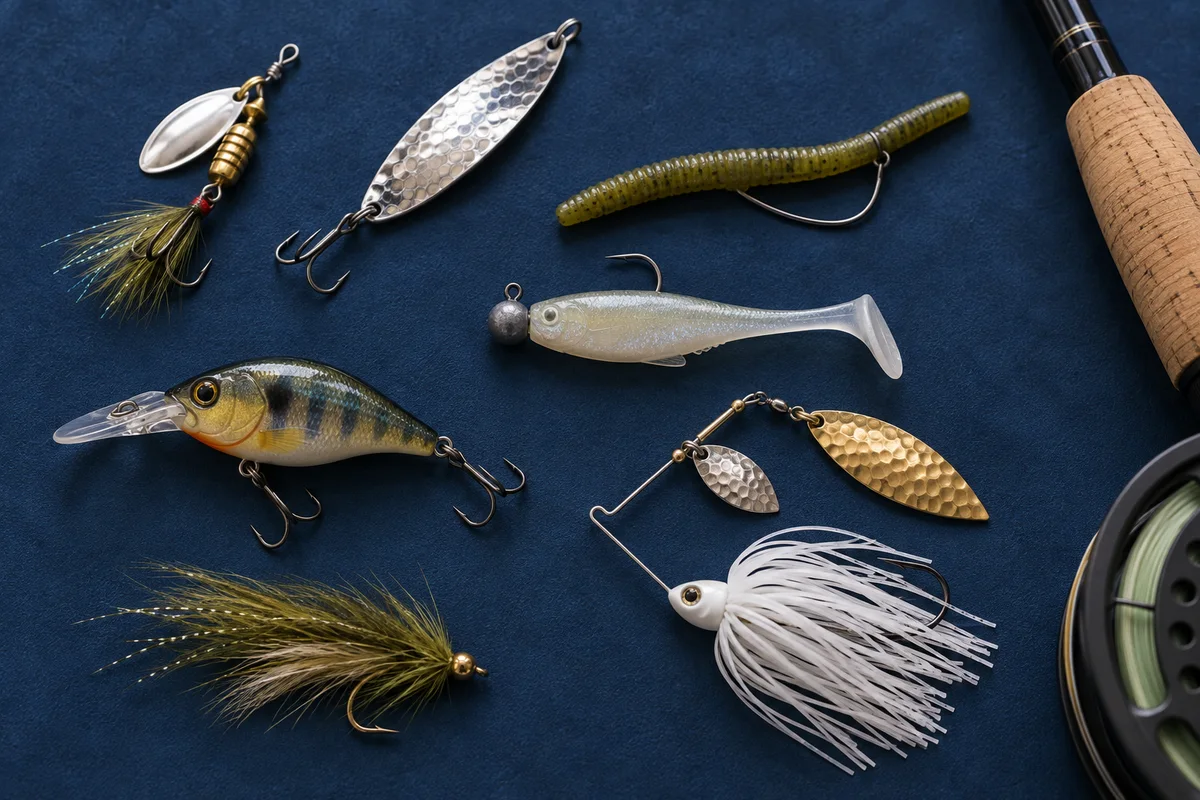
Quick answer: For trout, try a small inline spinner. For panfish, start with a small jig and grub. For bass near cover, try a Texas-rigged worm. Match the lure to the fish’s depth and your rod’s casting range, then adjust the retrieve. The finder below connects those choices.
Choose a target that lives in the water you plan to fish.
These are the main freshwater lure families, not every brand or specialized variation. Each has a job. Open a lure to learn its retrieve, weighting and limitations.
As an Amazon Associate, we earn from qualifying purchases. Shopping links open Amazon searches, not a specific tested product. Check the selected size, hook arrangement and material before buying.
Search for trout and panfish with a blade that turns around a straight wire shaft.
Flash & vibration
Trout · Panfish · Bass · Northern pike
The blade provides motion even with a simple straight retrieve. A spinner is a searching lure: fan casts across open water, then change the countdown to sample another depth. Its straight shaft distinguishes it from a wire-arm spinnerbait. If line twists, check for a fouled lure and consider a small quality swivel on the leader.
How to fish it: Cast across the area, let it sink briefly, then reel just fast enough to keep the blade turning. Check its action beside the bank first.
Weight: Use the built-in lure weight. A small 1/16–1/8 oz spinner is a starting point for trout; larger targets need larger versions.
Avoid: Thick weeds, a blade that will not start, or a retrieve so fast the lure rides out of the strike zone.
Imitate a small baitfish with a curved metal body that wobbles and flutters.
Flash & flutter
Trout · Northern pike · Walleye · Bass
A compact spoon can help reach fish beyond a short bank cast. Countdown controls its starting depth, but it does not establish an exact depth in feet. Retrieve speed, current, line and spoon shape change the path. Weedless spoons are a separate option with a guarded single hook; an ordinary treble-hook spoon is not weedless.
How to fish it: Let it sink to the intended depth, then retrieve slowly enough to wobble without rolling continuously. Add an occasional short pause.
Weight: The metal body supplies the casting weight. Start around 1/8–1/4 oz for trout, or 1/2–3/4 oz for pike, within your rod rating.
Avoid: Dragging a treble-hook spoon through vegetation or retrieving so fast it spins and twists the line.
Put a small soft plastic near fish at a chosen depth, with subtle movement at low speed.
Controlled depth
Trout · Panfish · Bass · Walleye · Channel catfish
Thread the plastic straight onto the hook so the tail can move freely. A jig is a way to control depth, not a requirement to bounce the bottom on every cast. Around suspended crappie, keep it at or just above the fish. Select a heavier head only when wind, current or depth prevents you from controlling the presentation.
How to fish it: Swim it slowly or lift it a short distance and let it fall on a controlled line. Watch for a sideways twitch or an unexpected stop.
Weight: The jig head supplies weight. Typical starting heads: 1/32–1/16 oz for panfish, 1/16–1/8 oz for trout, 1/8–3/8 oz for bass or walleye.
Avoid: A head so heavy that it plows into the bottom, or a crooked plastic that spins instead of swimming.
Give bass a slow, compact target around cover or when they ignore faster lures.
Slow & weedless
Bass
For a Texas rig, put the bullet sinker on the line first, tie the offset hook, then rig the worm straight with the point lightly hidden. A wacky rig hooks a stick worm through the middle for an exposed-hook fall in open water. A drop shot separates the weight below the hook to hold a small worm above bottom. They are different presentations, not interchangeable names.
How to fish it: Let a Texas-rigged worm fall beside cover, pause, then move it with short lifts. Reel up slack before setting the hook.
Weight: Fish weightless in shallow pockets or start with a 1/8–1/4 oz bullet sinker. Count the worm, hook and sinker in total casting weight.
Avoid: Burying the hook point too deeply, using a hook with too little gap, or mistaking a heavy sinker for better feel.
Swim a soft baitfish profile past feeding predators at a steady, controllable pace.
Baitfish imitation
Bass · Walleye · Northern pike · Trout · Panfish
Match the body to the fish: a micro version suits panfish, while pike need a larger profile and a bite-resistant leader. A weedless hook helps around stems and branches but does not make a lure snag-proof. In dense mats, fish holes and outside edges rather than trying to force a swimming lure through the canopy.
How to fish it: Thread it straight, then swim it just fast enough for the tail to kick. Pause at an edge and let it fall a little before continuing.
Weight: Use a jig head in open water or a weighted weedless hook by vegetation. Include the soft plastic in total casting weight.
Avoid: An exposed jig hook through thick weeds. A crooked body, oversized hook or buried tail can stop the swimming action.
Cover a band of water with a hard bait whose bill makes it dive and wobble.
Search & deflect
Bass · Walleye · Northern pike · Trout
Square bills are often used around shallow hard cover; longer bills can reach deeper. Casting distance and line diameter influence the actual running depth. Make first casts where a snag is recoverable and learn how the lure feels. A bill may deflect off wood, but exposed treble hooks still catch branches and weeds.
How to fish it: Reel to make it dive, then use a steady retrieve with pauses. Let a floating model rise away from an obstruction.
Weight: Use its own weight. Choose the labeled running-depth model; a heavier lure does not automatically dive deeper.
Avoid: A deep-diving model on a shallow snag-filled bank, or treating a package depth as exact for every cast.
Offer a darting baitfish that can remain near hesitant fish during a pause.
Twitch & pause
Bass · Trout · Walleye · Northern pike
Floating, suspending and sinking minnow baits behave differently when stopped. Check yours beside the bank before fishing it. A pause can be the useful part of the retrieve, especially when fish are slow. Suspended does not mean motionless under every temperature, line or snap combination.
How to fish it: Reel down, give one or two short twitches, then pause. Experiment with longer pauses when fish follow without striking.
Weight: No extra sinker by default. Use the model’s weight and depth rating; leader and hardware changes can alter suspension.
Avoid: Constant hard jerking with no pause, slack so large that a bite cannot be detected, or exposed hooks near dense cover.
Search bass and pike water with flashing blades above a skirted single hook.
Vibration around cover
Bass · Northern pike
The bent wire separates the blades from the hook and helps the bait pass scattered cover. It remains vulnerable to stringy weeds. Tie at the line attachment specified by the maker; an open R-bend is generally tied directly so a loose snap cannot slide along the wire. Use a closed-eye model with suitable leader hardware for pike.
How to fish it: Swim it along the outside of grass or beside wood, keeping the blades turning. Slow down to run deeper without losing blade action.
Weight: Start around 3/8 oz for bass, matched to your rod. Head-weight labels may exclude the blades, wire and skirt.
Avoid: Confusing it with a small trout spinner, or pulling it through a solid mat of floating vegetation.
Combine a skirted jig and vibrating blade to search grass edges for bass.
Strong vibration
Bass · Northern pike
The blade at the head vibrates differently from the rotating blades of a spinnerbait. A soft plastic trailer changes bulk, lift and action; start with a modest size that leaves the hook gap clear. If the vibration disappears, check for grass before deciding the fish have stopped biting.
How to fish it: Start the blade with a short pull, then swim it so you can feel a regular vibration. Pause briefly beside gaps in grass.
Weight: A 3/8 oz head is a common bass starting example. Add trailer weight when checking the rod’s casting range.
Avoid: Treating it as a bottom jig in tangled wood, or repeatedly forcing a fouled blade through heavy mats.
Use a sinking, vibrating hard bait to cover open water or the tops of submerged grass.
Fast search
Bass · Walleye · Northern pike
Unlike a billed crankbait, a lipless model sinks and lets you select a starting depth. That flexibility brings snag risk, particularly when fishing back uphill from shore. Use it where you know the bottom or keep it above cover. A compact profile can cast well but is not automatically appropriate for an ultralight rod.
How to fish it: Count it down over clean bottom, then swim it or lift and let it fall. Keep enough line contact to notice a bite on the drop.
Weight: The bait is already weighted. A 1/4–1/2 oz version is a starting example for bass or walleye, within the rod range.
Avoid: Long uncontrolled drops into rocks, wood or thick vegetation where the treble hooks can snag.
Present a compact crawfish-like meal next to bass holding by wood, rock or grass.
Bottom & cover
Bass
A weed guard reduces some snagging but must flex enough for the hook to engage. Football heads suit many rock presentations; pointed grass heads pass stems more easily; swim jigs are shaped for moving retrieves. Those are jobs within the jig family. Match the head to the job before changing the skirt color.
How to fish it: Pitch close to cover, let it fall, then use small lifts and pauses. Watch the line on the first fall.
Weight: Start around a 1/4–3/8 oz head and add a trailer. Choose a head shape suited to the cover; heavier is not always better.
Avoid: An oversized trailer that blocks the hook, or a football head jammed through dense vegetation.
Offer a hollow, tentacled profile for smallmouth bass, or tiny versions for crappie.
Bottom forage
Bass · Panfish
The hollow body can conceal the jig head and creates a different profile from a worm. A small crappie tube and a bass tube require very different hook sizes. Rig straight, leave the hook gap clear, and reduce the head weight if every hop wedges it between rocks.
How to fish it: Let it settle, then use short hops or a slow swim. Keep the tentacles free and watch for bites as it falls.
Weight: An internal tube jig adds weight. Start with a head that controls the fall, then account for the tube’s weight too.
Avoid: Assuming an internal jig is weedless; an exposed hook still snags. Use a suitable offset-hook rig around cover.
Call attention to a surface target with a cupped face and short popping movements.
Surface disturbance
Bass · Panfish
Surface lures are useful when fish are willing to rise, not simply because the water is shallow. Calm pockets make a small pop easier to notice. Walking baits are a related surface family: side-to-side twitches replace the popper’s cupped-face splash. If fish repeatedly miss, try a smaller surface bait or a shallow subsurface lure.
How to fish it: Cast near an open edge, let the rings settle, then pop and pause. Let the fish load the rod before pulling against it.
Weight: Use its built-in weight with no sinker. Small panfish poppers may need fly gear or a casting float rather than a heavy spinning rod.
Avoid: Treble hooks in floating grass, or adding a sinker that pulls a surface lure underwater.
Give bass a surface target over floating vegetation and through shallow openings.
Surface over vegetation
Bass
A collapsible body shields upward-facing hooks. It needs more hook-setting power than a tiny open-hook jig, so the same rod and line should not be suggested for both. Squeeze accumulated water out between casts. If fish stay under the mat, a subsurface weedless presentation in an opening may be a better choice.
How to fish it: Work slowly across the canopy and pause at holes. When a fish takes it, reel to feel the fish before a firm hookset.
Weight: No extra sinker. Use a rod rated for the full frog weight and strong line suited to pulling fish from vegetation.
Avoid: Light trout tackle, striking at the splash before feeling the fish, or assuming a frog is the best cold-water bait.
Cover shallow bass water with a rotating surface blade and a single hook.
Moving surface search
Bass
Most buzzbaits sink when stopped. Their role is a continuous moving surface presentation, while a floating popper can sit still. Choose it when bass appear willing to chase. Use a frog for a dense floating mat, or a slower floating lure when a long pause seems to draw more interest.
How to fish it: Begin reeling as it lands and hold a steady pace that keeps the blade on the surface. Trace the edge of cover.
Weight: The head supplies weight. No added sinker; count any trailer in the full casting load.
Avoid: Pausing and expecting it to float like a popper, or pulling it through a solid grass canopy.
Match surface insects, drifting underwater food or small swimming prey, especially for trout.
Insects & small forage
Trout · Panfish · Bass
Dry flies float, nymphs imitate underwater immature insects, and streamers suggest larger swimming food. The term fly describes construction, not a promise of surface fishing. Match the method before choosing a pattern, and use the hatch calendar for seasonal insect context. The lure finder prioritizes spinning presentations; fly gear is an alternative lesson.
How to fish it: Drift a dry fly or nymph naturally with the current. Fish a streamer with short strips or swings to suggest swimming prey.
Weight: Fly line normally supplies casting weight. A nymph may carry a bead or use permitted split shot; a spinning outfit needs an appropriate casting-float rig.
Avoid: Casting a nearly weightless fly alone on a heavy spinning setup, or dragging a dry fly underwater with a sinker.
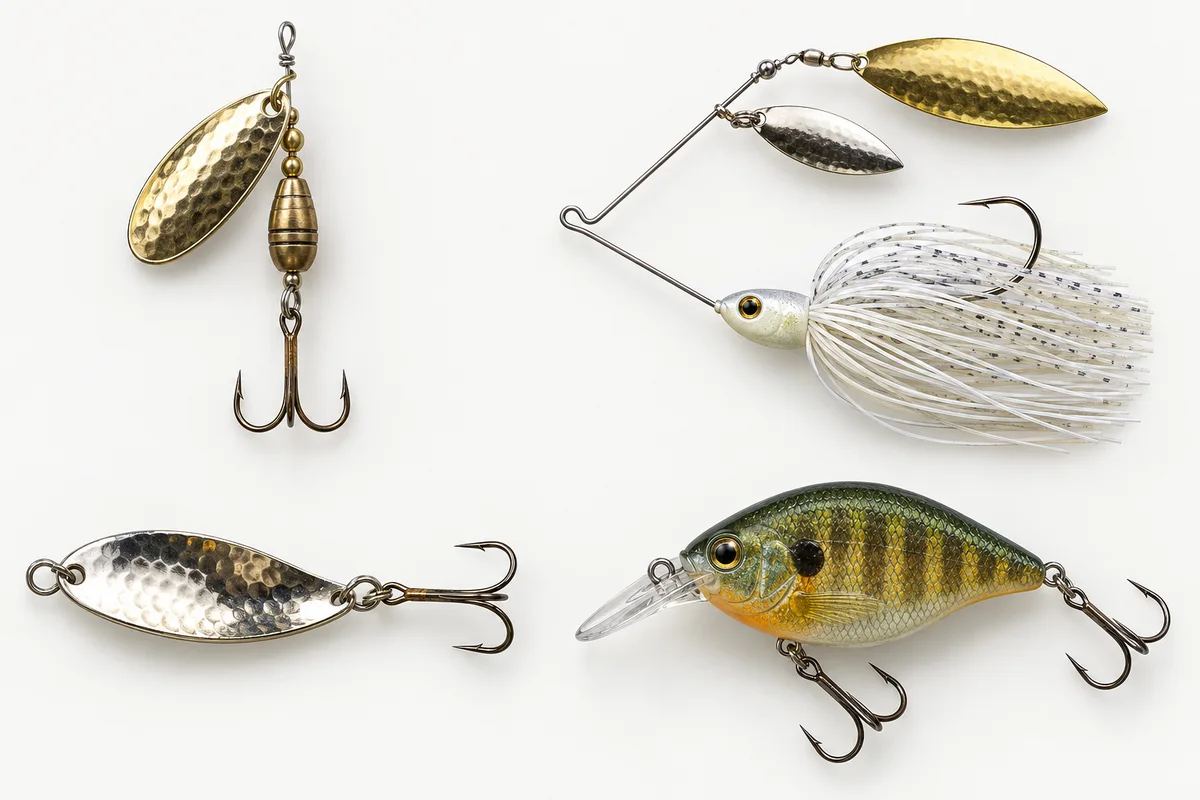
Similar names, different shapes. An inline spinner is a compact search lure. The bent wire on a spinnerbait separates the blades from a skirted hook for working around scattered cover.
Depth first. A good lure above or below the fish can go unnoticed. In open water, compare short and longer countdowns with a sinking lure. Watch for bottom contact rather than treating seconds as a depth measurement.
Then cover. Exposed hooks are simple to use in open water. Around vegetation, use a suitable weedless hook or fish outside the grass. A hollow-body frog can cross a floating canopy; a spinnerbait generally cannot.
Then movement. A steady retrieve is easier to repeat than random rod movements. When fish follow without taking, try a pause or a smaller profile. If nothing changes, try another depth or location.
Finally color. Natural forage colors are a reasonable clear-water start. In stained water, compare contrast and vibration. Treat color advice as an experiment, not a rule that works on every lake.
Selection principles: Take Me Fishing: choosing freshwater lures. The finder’s specific combinations are editorial starting recommendations.
Learn the improved clinch for light mono, the Palomar for a compact terminal connection, the Uni for flexibility, and when a loop knot helps a lure move.
Learn fishing knots, step by step →Rod power is not rod action. Line strength is not fish weight. A 1/8 oz jig head plus a plastic weighs more than 1/8 oz. Here is how to put the numbers together.
Match your rod, line & lure weight →Start with a small inline spinner for trout, a small jig and grub for panfish, or a Texas-rigged soft plastic worm for bass. Choose a lure your rod can cast, then adjust depth and retrieve before buying more colors.
Usually not with a spinner, spoon, crankbait or topwater lure: its own body provides casting weight. Soft plastic rigs may need a jig head, bullet weight or drop-shot sinker. Count every part of the rig toward the rod’s lure-weight limit.
An inline spinner has a blade rotating around a straight shaft and commonly targets trout or panfish in smaller sizes. A wire-arm spinnerbait separates its blades from a skirted single hook and is commonly used for bass or pike around scattered cover.
Try a strong silhouette or a bright contrasting color, and consider a lure with vibration. Those are starting experiments, not guaranteed color rules. Depth, location and a retrieve fish can track matter as well.
First check whether your lure reaches the fish. Then slow the retrieve, lengthen pauses or reduce the profile. A small jig, soft plastic worm or suspending jerkbait can help you test a slower presentation. Move if the area shows no signs of fish.
Sometimes, if the lure and line fall inside its ratings. A light rod for tiny trout lures is poorly suited to heavy bass jigs or frogs in thick vegetation. Match the total casting weight and the hook-setting demands, not just the fish’s name.
Channel catfish can take artificial lures, especially when actively feeding, but lawful natural bait is often a more practical beginner choice. The finder explains this rather than treating a lure as the best answer for every species.
No. It uses the conditions you choose and transparent editorial rules. The recommendations are starting points, not catch predictions. Check official local regulations, fish availability and current conditions before your trip.
The finder first matches the fish and usable cover, then compares depth, water movement, clarity and feeding activity. Surface lures are excluded for deeper targets. Fly presentations stay in the reference because they need a different casting setup. If light-tackle fish are near dense cover, the result tells you to fish openings and edges.
Weights and line ranges are practical starting examples. Use the actual rod, lure and line maker’s instructions to refine them. No local weather, water temperature, stocking record or catch probability is inferred from your answers.
Before casting: Check the current rules for your exact water, including permitted hooks, bait, scented plastics and tackle materials. Find your state’s official agency links. Pick up discarded line and soft plastics.
Prepared by USA Stocked Fish. Sources checked September 11, 2026. Generated images illustrate lure families; they are not product photographs or knot-tying instructions.
Explore fly hatches · Learn stocked trout fishing · Browse the gear directory