The current report
Georgia’s official trout fishing page currently links a Weekly Stocking Report for August 3–7, 2026. The page also links the 2026 stocking-frequency document and a trout-stream interactive map.
Georgia says its partnership with the U.S. Fish and Wildlife Service allows 160 streams to be stocked with rainbow, brown, and brook trout from late March through October. The state says stocking frequency depends on fishing pressure, accessibility, and water conditions.
The weekly report is therefore a current lead, not a guarantee that every stream is open, public, cool, or still holding recently released fish.
What the local snapshot shows
USAStockedFish’s local Georgia snapshot was retrieved July 19, 2026. It contains 40 completed trout rows dated July 13–17. The sample below shows the kinds of waters in the snapshot:
| Date | Water | County | Species | Status |
|---|---|---|---|---|
| July 17, 2026 | Chattahoochee River (WMA) | White County | Trout | Completed |
| July 17, 2026 | Jasus Creek | White County | Trout | Completed |
| July 17, 2026 | Little Cedar Creek | Floyd County | Trout | Completed |
| July 17, 2026 | Low Gap Creek | White County | Trout | Completed |
| July 17, 2026 | Mt. Hope Creek | Floyd County | Trout | Completed |
The local table is a dated reference. The Georgia DNR page and current weekly report control what is current.
Use the map to understand recency
Georgia’s trout-stream interactive map is especially useful because it distinguishes recent activity visually. The state says streams stocked in the last week are highlighted in bright yellow, while streams stocked the week before—8 to 14 days earlier—use another color.
The map should be read with the report date:
- Confirm which weekly report is open.
- Use the map to find the stream or reach.
- Check the map legend and the exact water.
- Open current regulations and access information.
- Re-check conditions close to departure.
The map’s color does not tell you that a fish is still present or that the stream is fishing well. It tells you how the agency is classifying recent stocking activity.
Georgia trout species and season
Georgia’s program includes:
- rainbow trout;
- brown trout;
- brook trout.
The state page describes catchable-sized rainbow and brown trout as 9–11 inches. That size description helps explain the program, but it does not replace the specific report for a water.
The state says stocking can run from late March through October. That is a program window, not a promise that every stream receives fish on every week. The number of fish and frequency vary with pressure, access, and water conditions.
Use the rainbow trout, brown trout, and brook trout pages for general fish context. Keep the Georgia DNR page as the source for current waters and rules.
Access is part of the stocking question
Georgia warns that many trout streams are on private property. The agency says it is the angler’s responsibility to know when a property line is crossed and to obtain permission before fishing private water.
That means “stocked” does not automatically mean “public.” Before you leave, verify:
- whether the exact reach is public;
- where parking and legal entry are located;
- whether a landowner permission requirement applies;
- whether a stream is in a state or federal recreation area;
- whether there are current closures or access restrictions.
For a metro-Atlanta starting point, Georgia’s page discusses the Chattahoochee River downstream of Buford Dam and links the Chattahoochee River National Recreation Area. It also lists special regulation streams and locations such as the Toccoa River, Tallulah River, Johns Creek, and Cooper Creek. Use those recommendations as navigation into official pages, not as a substitute for the current rules.
Special regulations can change the plan
Georgia lists special-regulation waters including artificial-lures-only streams, delayed-harvest streams, age-restricted waters, and trophy trout water. The Chattahoochee River and Toccoa River are not interchangeable with every stocked stream.
The Georgia page says anglers age 16 or older need both a fishing license and a trout license. Confirm the current license and rules at the state’s official source before fishing. A stocking report does not establish a daily limit, legal method, size rule, or harvest status.
A source-first trip checklist
Use this sequence:
- Open the current weekly report.
- Identify the stream and county.
- Confirm the report date.
- Use the trout-stream map to inspect recent-stocking color and the exact reach.
- Check public access or landowner permission.
- Read the regulation category for that water.
- Check current flow, temperature, weather, and closure information.
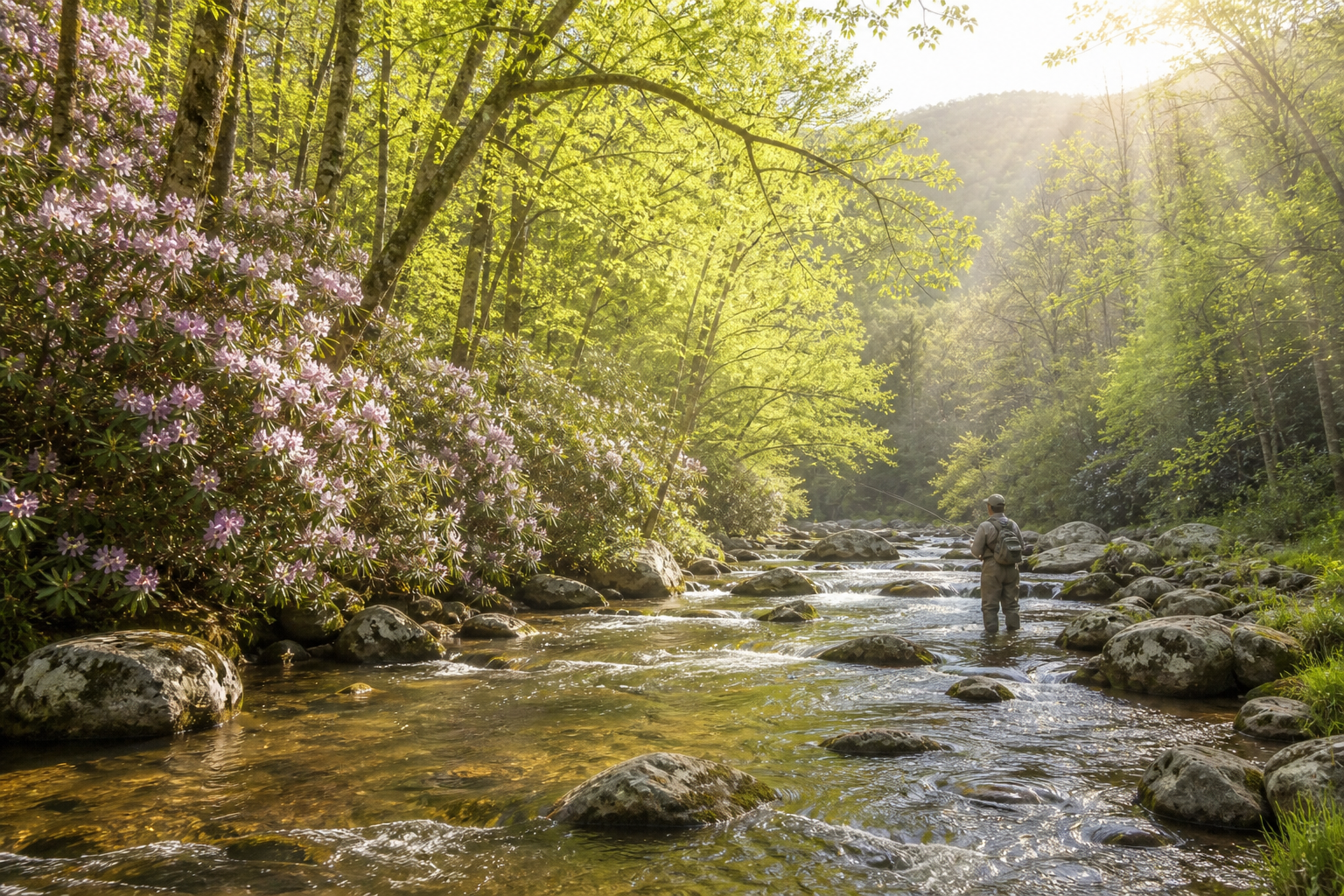
The hero image on this page is illustrative. It does not show the current color, flow, crowd level, or weather of a Georgia stream.
The Georgia state page provides program context. The near-me stocking tool can help you compare dated rows, but the weekly report and map remain the source of record.
Frequently asked questions
Where is Georgia’s weekly trout stocking report?
Use the Georgia DNR trout page. It links the current weekly report, the stocking-frequency document, the trout-stream map, and license resources.
How long does a Georgia stocking report stay current?
The page is organized around weekly reports. Read the report date and map legend, then reopen the page before a time-sensitive trip.
Do I need a trout license in Georgia?
Georgia’s trout page says anglers age 16 or older need a fishing license and a trout license. Verify the current requirement and purchase information on the official page.
Does a stocked Georgia stream guarantee fish?
No. Stocking frequency, access, water conditions, fishing pressure, regulations, and fish movement all affect the trip. Treat the weekly report as current stocking intelligence, not a catch-rate promise.